
Beginner solving guide
Star Battle tips for one-star puzzles
A useful next move often starts with a square you can cross out. These techniques use Sprig’s one-star rules: one per row, column and region, with none touching.
New to the puzzle? Read the Star Battle rules or how to play Sprig first. Two-star puzzles need different counts; the one-star deductions below should not be applied unchanged.
1. Finish the exclusions after every placement
When you place a Sprig, mark every other square in its row, column and coloured region with X. Also mark every square touching it, including diagonal corners. Missing just one of these exclusions can hide the next forced move.
Work in the same order each time: row, column, region, neighbours. Then look for the next deduction.
2. Find the last available square
An unfinished row, column or region must still get its Sprig. If only one square is possible, it is forced. Check all three kinds of area: a row may look open even while a coloured region has just one choice.
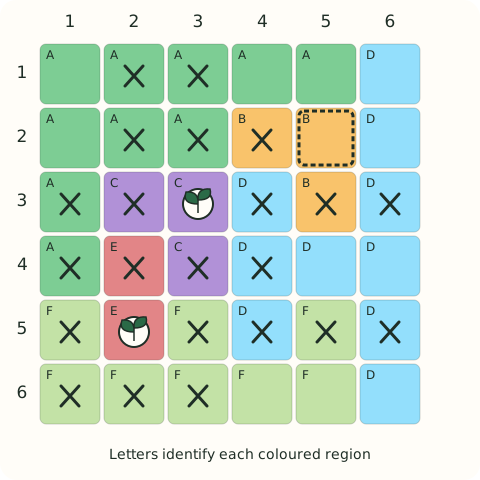
You do not need to know the rest of the solution. Region B needs one Sprig, and every other square in it is impossible. After placing it, repeat the exclusion checks.
3. Use a region that is confined to one line
Suppose a region’s only possible squares are all in row 4. You may not know which square is right, but you know that region’s Sprig must occupy row 4. In a one-star puzzle, every square in row 4 outside that region can therefore be crossed out.
The same reasoning works for a column. It also works in reverse: if all of a row’s possible squares belong to one region, that region’s Sprig must be in that row. Cross out the region’s other squares.
4. Let two regions reserve two lines
If two unfinished regions can place their Sprigs only in columns 2 and 5, those two columns are reserved for those regions. Each region needs one Sprig, and each column has room for one, so the two Sprigs must use one column each.
Cross out other regions’ squares in columns 2 and 5. You still do not need to decide which of the two regions uses which column. This also works with two rows.
5. Check what every option has in common
A region may have two possible squares without forcing a placement yet. If another square touches both options, it cannot contain a Sprig: whichever option is correct, the no-touching rule rules it out.
Only mark squares blocked by every remaining option. A square touching just one candidate may still be valid.
6. Recheck the small areas when you get stuck
After each new X, revisit the rows, columns and regions with the fewest choices. A single exclusion can turn two candidates into one. On the browser board, region letters help you track the areas as well as their colours.
Every Sprig practice board has one solution. If your notes leave a required area with no possible square, review the most recent deduction. In the iPhone and Android apps, Wisp can explain a next step and why it works.
Put the techniques to work on the daily Sprig, or on any earlier day’s board from the daily archive.